Data Sources/Global Human Settlement Layer (GHSL)

Global Human Settlement Layer (GHSL)

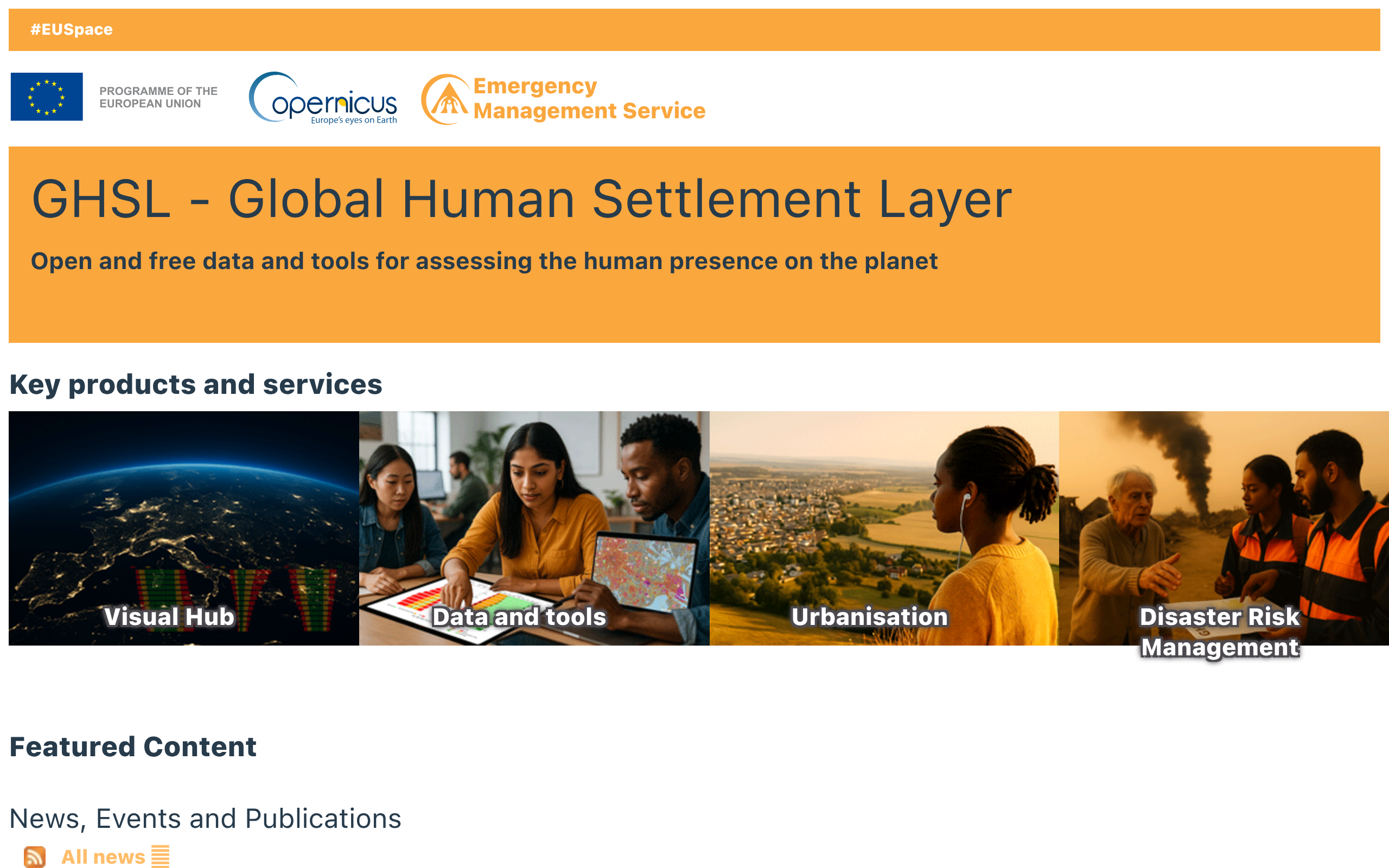
The Global Human Settlement Layer (GHSL) is a free dataset from the European Commission's Joint Research Centre mapping human settlements, population distribution, and urban extent globally from 1975 to present. Used for urban growth analysis, disaster risk assessment, and population modeling.

Urban Planning

Plan urban development, zoning, and infrastructure improvements using land cover, demographic, and transportation data.

Disaster Response

Support rapid disaster assessment, emergency management, and recovery efforts with real-time and historical hazard data.

Environmental Monitoring

Track environmental changes including deforestation, pollution levels, and ecosystem health using Earth observation data.

Global Human Settlement Layer (GHSL)

The Global Human Settlement Layer (GHSL) is the most comprehensive free dataset for mapping where humans live and how human settlements have changed over the past five decades — produced by the European Commission's Joint Research Centre using satellite imagery and census data.

The dataset answers fundamental questions in urban and population geography: Where are buildings? How many people live there? How has that changed since 1975? At 10-meter resolution globally, GHSL provides answers at a scale and coverage that no other free dataset matches.

The multi-temporal design is what distinguishes GHSL from snapshot products. With consistent data for 1975, 1990, 2000, 2015, and 2020, analysts can track urban expansion around any city, measure the rate of rural-to-urban migration, or quantify infrastructure exposure growth in flood or earthquake zones. A city that appears stable in a current basemap may reveal decades of sprawl when examined through the GHSL time series.

The urbanization classification layer (GHSL-SMOD) implements the Degree of Urbanization standard adopted by the UN and Eurostat, providing consistent categories — urban centres, urban clusters, suburban areas, low-density rural, and very low density rural — that align with policy-relevant definitions of what counts as "urban." This makes GHSL data directly comparable across countries without the definitional inconsistencies that plague national urban statistics.

For disaster risk analysis, GHSL population grids provide sub-national exposure estimates that are more current and consistent than census data in many countries. Agencies including UNDRR, the World Bank, and national disaster management organizations use GHSL-derived exposure metrics in disaster risk assessments and the Sendai Framework monitoring process.

Data is distributed as GeoTIFF rasters through the JRC Data Catalogue and can be accessed via the GHSL download interface without registration.

Frequently Asked Questions

Four main layers — GHSL-BUILT (built-up surface extent), GHSL-POP (population distribution), GHSL-SMOD (degree of urbanization), and GHSL-DUC (urban centers) — all at 10m to 1km resolution depending on the layer and epoch.

GHSL provides data for multiple epochs from 1975 to 2030 (modeled), with key snapshots at 1975, 1990, 2000, 2015, and 2020. This multi-temporal coverage enables urban growth analysis over five decades.

Yes. All GHSL data is free and openly available for download without registration. Published under a Creative Commons license permitting commercial and non-commercial use with attribution.

The built-up surface layer is available at 10m resolution (derived from Sentinel-2 and Landsat). Population and urbanization layers are typically at 100m and 1km resolution.

Map urban extent and built-up density, calculate urban growth rates between epochs, estimate population in any drawn area, classify settlements by urbanization degree (urban centers, urban clusters, rural), and support disaster exposure modeling.

Details

CoverageGlobal
Layer TypeRaster
Update FrequencyPeriodic (major releases every few years)
Categories
DemographicsUrbanRemote Sensing
Visit sourceUse data in Atlas

Discover more data sources

Overture Maps

Overture Maps offers open, high-quality map data by integrating contributions from various organizations, ensuring comprehensive and accurate geospatial information.

Mapping

World Resources Institute

The World Resources Institute (WRI) provides free, high-quality environmental data for GIS, climate research, and sustainability projects.

Climate

MODIS

MODIS provides free, global satellite data for climate monitoring, land cover analysis, and disaster response.

Remote Sensing

Natural Earth

Natural Earth is a free and open-source GIS data source, providing high-quality vector and raster datasets for cartographers, researchers, and GIS professionals. With political boundaries, physical geography, and infrastructure data, it's easy to use and well-organized. Available in multiple scales and standard formats, Natural Earth is a must-have for mapping and spatial analysis projects. Download it today!

Mapping

Ministerio de Transportes

Explore GIS data sources from the Ministries of Transport in Spain, Colombia, and Peru. Access transportation networks, infrastructure, and mobility data for planning and analysis.

Demographic

STAC Index

The STAC Index catalogs open, cloud-native geospatial datasets using the STAC metadata standard.

Demographic

Microsoft Planetary Computer

Free cloud platform with petabytes of geospatial data and integrated compute for large-scale Earth science.

Remote Sensing, Climate

TIGER/Line

TIGER/Line shapefiles from the U.S. Census Bureau are essential for mapping geographic boundaries like tracts, counties, and ZIP codes.

Demographic