Data Sources/OpenTopography

OpenTopography

OpenTopography provides free, high-resolution elevation and LiDAR data for GIS, remote sensing, and environmental analysis.

Infrastructure Development

Plan, monitor, and manage roads, utilities, and buildings using topographic, cadastral, and engineering data.

Disaster Response

Support rapid disaster assessment, emergency management, and recovery efforts with real-time and historical hazard data.

Renewable Energy

Identify optimal locations for solar, wind, and other renewable energy installations using terrain and climate data.

OpenTopography

OpenTopography solves a practical problem with high-resolution elevation data: LiDAR point clouds are enormous, require specialized software to process, and are scattered across dozens of different agency and institutional repositories.

OpenTopography centralizes access to these datasets and adds cloud-based processing on top — so you can generate custom DEMs, hillshade maps, slope and aspect products, and hydrological derivatives from raw point clouds without downloading gigabytes of data and running processing pipelines locally. Funded by NSF and operated in partnership with USGS, it's the largest community-accessible portal for topographic data at resolutions from sub-meter LiDAR to global 30-meter satellite DEMs.

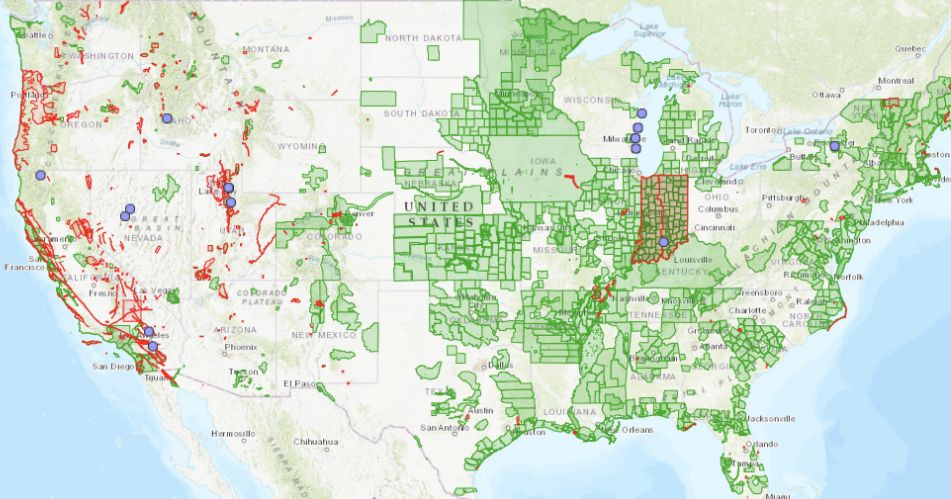
The platform matters most for projects that need elevation detail beyond what global DEMs provide. SRTM and Copernicus DEM give you 30-meter or 90-meter resolution worldwide, which is sufficient for regional terrain analysis — but infrastructure engineering, flood modeling at local scale, landslide assessment, forestry canopy studies, and archaeological surveys often need the sub-meter precision that only LiDAR delivers.

OpenTopography makes that data accessible without commissioning a survey or purchasing from commercial providers. Coverage is strongest in the United States (particularly through the USGS 3DEP program), with growing collections from Europe, New Zealand, and other regions contributed by research institutions. For areas where LiDAR hasn't been flown, OpenTopography also provides convenient access to the global satellite DEMs as a fallback.

How to use OpenTopography in Atlas?

Frequently Asked Questions

A web-based portal providing free access to high-resolution topographic data including LiDAR point clouds, DEMs, and photogrammetric datasets from research and government sources worldwide.

Airborne LiDAR, terrestrial LiDAR, structure-from-motion photogrammetry, satellite-derived DEMs (SRTM, ALOS), and bathymetric datasets.

Yes. All data access is free. Registration is required for on-demand processing of LiDAR point clouds into custom DEM products.

Varies by dataset. LiDAR data typically ranges from 0.5 to 2 meters. Global datasets like SRTM are at 30 meters. Some photogrammetric datasets reach centimeter resolution.

GeoTIFF for raster DEMs, LAS/LAZ for LiDAR point clouds. The platform also offers on-demand processing to generate hillshade, slope, and aspect products.

Details

CoverageGlobal
Layer TypeRaster
Update FrequencyVaries by dataset
Categories
Elevation
Visit sourceUse data in Atlas

Discover more data sources

FAO GeoNetwork

FAO GeoNetwork provides free, high-quality geospatial data for agriculture, food security, land use, and climate research. With global datasets, interactive maps, and GIS-ready formats, it's an essential tool for researchers, policymakers, and sustainability experts.

Biodiversity, Climate

European Space Agency

ESA Earth Observation Data provides free, high-resolution satellite imagery from the Sentinel missions, covering land, ocean, and atmosphere. With data for climate monitoring, disaster response, and GIS applications, it's a top resource for researchers and professionals.

Remote Sensing

Google Earth Engine

Google Earth Engine provides free, cloud-based access to satellite imagery, climate data, and geospatial analytics.

Remote Sensing

MODIS

MODIS provides free, global satellite data for climate monitoring, land cover analysis, and disaster response.

Remote Sensing

SoilGrids

Global soil property maps at 250m resolution covering texture, organic carbon, pH, and more from ISRIC.

Biodiversity, Climate

Geoplatform.gov

A hub for the discovery and distribution of geospatial data, analytics, and tools

Remote Sensing

Global Fishing Watch

Global Fishing Watch provides free, open access data on global commercial fishing activity derived from vessel tracking systems (AIS). It enables monitoring of fishing vessels in near real-time, supporting marine conservation, fisheries management, and illegal fishing detection.

Marine, Environmental, Real-time

ESA WorldCover

Free 10-meter resolution global land cover from Sentinel-1 and Sentinel-2, classifying 11 land cover types.

Remote Sensing, Mapping