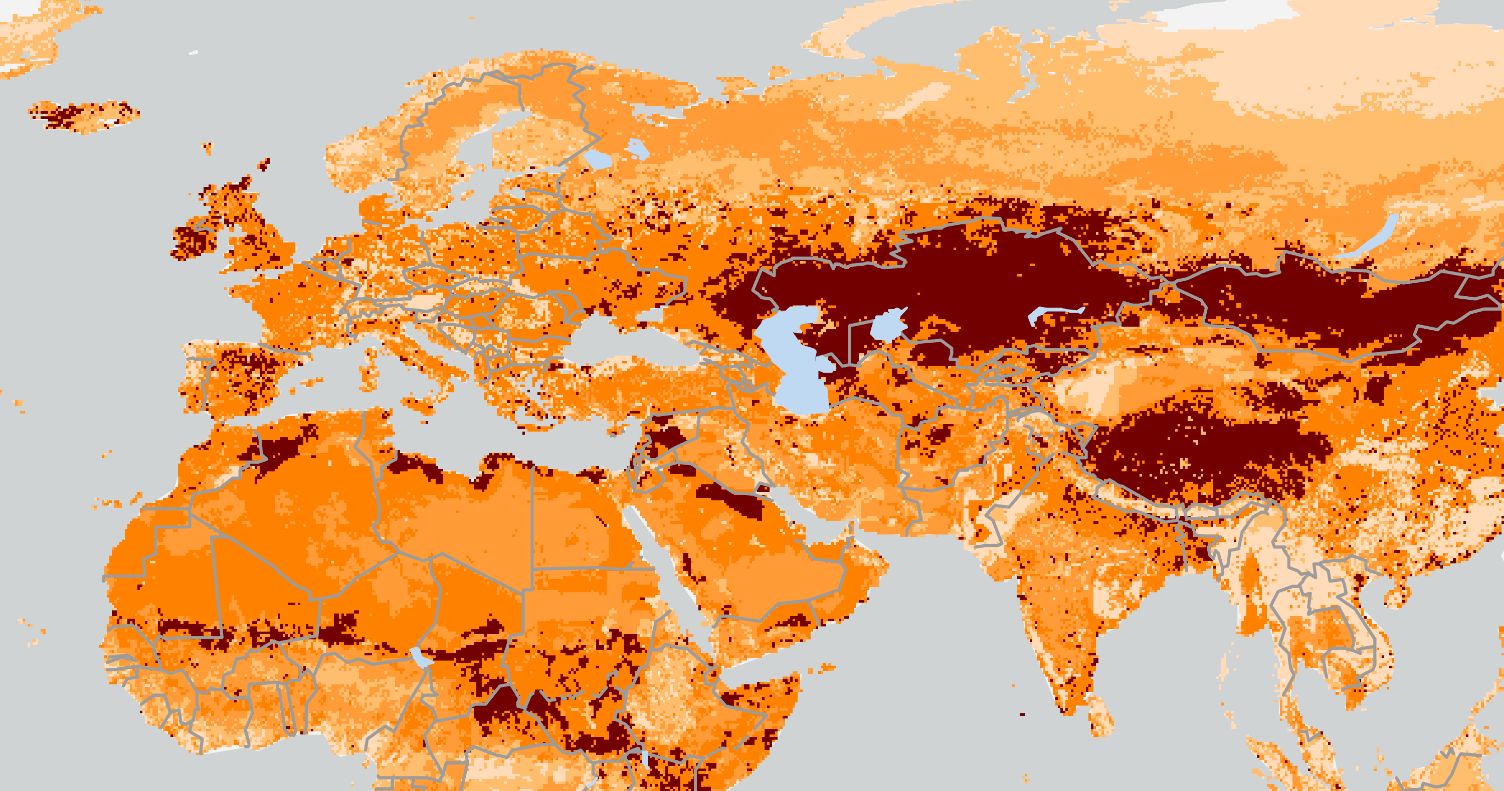
The United Nations Environment Programme (UNEP) is the only UN agency dedicated entirely to the environment, and its data platforms reflect that breadth — covering air quality, freshwater, biodiversity, land degradation, greenhouse gas emissions, marine health, and waste management under one umbrella. Where most environmental data sources on this page focus on a single domain (FIRMS for fire, GBIF for biodiversity, ERA5 for climate), UNEP aggregates cross-domain indicators from satellite imagery, ground stations, national reports, and partner agencies into country-level and global datasets.
For GIS analysts working on environmental policy, sustainability reporting, or SDG tracking, UNEP provides the thematic indicators that satellite imagery alone doesn't capture.
The most GIS-relevant arm of UNEP is UNEP-WCMC (World Conservation Monitoring Centre), which maintains the World Database on Protected Areas — the global reference dataset for conservation boundaries — along with spatial layers for biodiversity, habitat, and ecosystem services. The World Environment Situation Room adds near-real-time satellite-derived indicators that provide country-level environmental snapshots, while UNEP Live compiles hundreds of statistical indicators from member states.
The data is strongest as a source of harmonized environmental indicators at national and regional scale; for fine-resolution spatial analysis, the underlying datasets UNEP draws from (Copernicus, MODIS, national agencies) typically offer more detail. UNEP's value is in the synthesis — bringing disparate environmental themes together in a consistent, policy-relevant framework.
