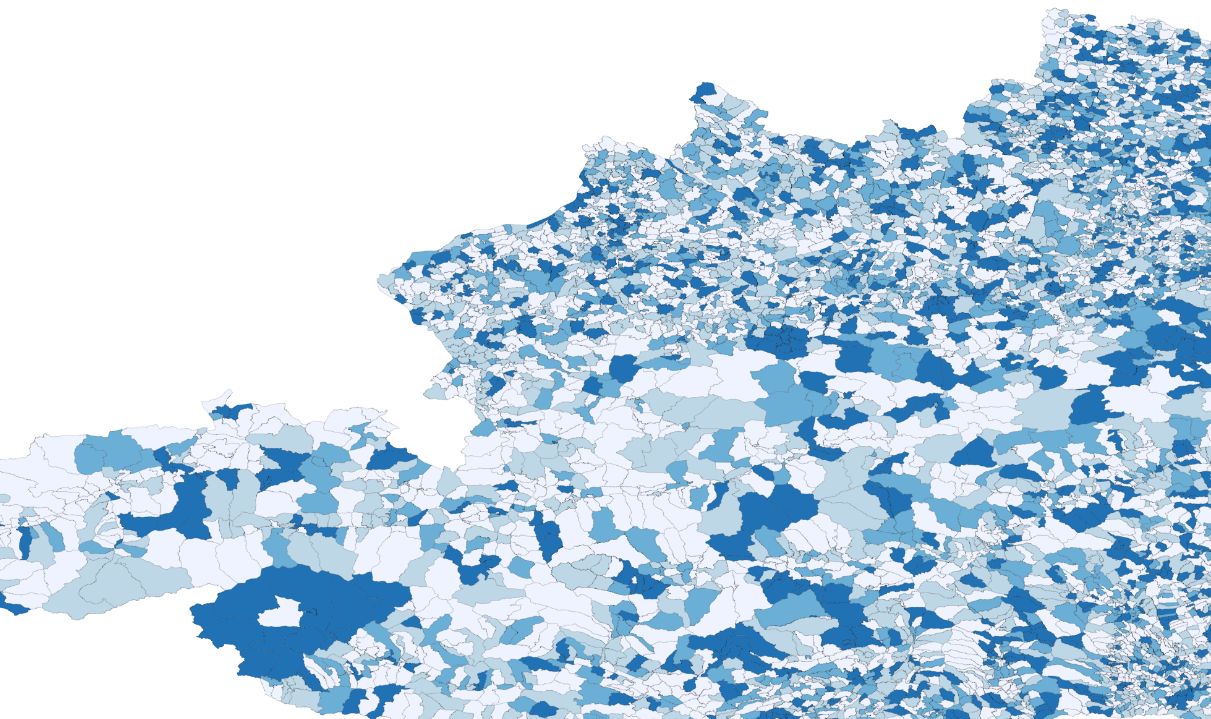
Data Sources/Global Administrative Areas

Global Administrative Areas

Global Administrative Areas (GADM) provides free, high-resolution administrative boundary data for every country. With detailed subdivisions, multi-level GIS support, and global coverage, it's a must-have resource for urban planning, policy research, and geospatial analysis.

Territory Planning

Design and optimize sales territories, service areas, and administrative boundaries for maximum coverage and efficiency.

Demographic Analysis

Understand population distribution, socioeconomic trends, and community characteristics through spatial demographic data.

Humanitarian Aid

Coordinate disaster relief, refugee support, and development programs using population and crisis data.

Global Administrative Areas

GADM (Global Administrative Areas) is the dataset most GIS professionals reach for when they need administrative boundaries outside their home country.

National statistical agencies publish their own boundary files, but each uses different formats, projections, attribute schemas, and licensing terms. GADM solves this by providing a single, consistently structured global dataset — same attribute naming, same level hierarchy, same download format — for every country. That consistency is what makes it practical for cross-border analysis, multinational reporting, and any project that needs to aggregate or compare data across countries without first harmonizing a patchwork of national boundary sources.

The other role GADM fills is as a base layer for joining tabular data to geography. Census tables, health statistics, election results, and economic indicators are all published against administrative units — and GADM provides the polygons those tables attach to. This makes it a foundational layer in workflows spanning demographic analysis, market research, public health mapping, and humanitarian response.

For countries where official boundary files are difficult to access or not published openly, GADM is often the only practical option at sub-national resolution. The main consideration is licensing: GADM is free for academic and non-commercial use, but commercial projects should evaluate geoBoundaries as an alternative with a fully open license.

How to use Global Administrative Areas in Atlas?

Frequently Asked Questions

The Global Administrative Areas database provides high-resolution boundary data for all countries and their administrative subdivisions (states, provinces, districts, municipalities) worldwide.

Up to 5 levels depending on the country — from national (level 0) down to local administrative units (levels 1-5). The number of available levels varies by country.

GADM is free for academic and non-commercial use. Commercial use requires a license from the GADM project.

GeoPackage, Shapefile, KMZ (Google Earth), and R spatial data objects. Available for individual countries or as a complete global dataset.

GADM often has more administrative levels and finer detail. geoBoundaries offers a fully open CC BY license allowing commercial use without restriction, while GADM restricts commercial use.

Details

CoverageGlobal
Layer TypeVector
Update FrequencyPeriodic
Categories
Mapping
Visit sourceUse data in Atlas

Discover more data sources

Marine Regions

Marine Regions is a standard list of georeferenced marine names and boundaries combining multiple authoritative sources, including Exclusive Economic Zones (EEZs), the IHO Sea Areas, and other marine geographic features. Essential for ocean GIS, fisheries management, and maritime policy analysis.

Marine, Boundaries, Environmental

MODIS

MODIS provides free, global satellite data for climate monitoring, land cover analysis, and disaster response.

Remote Sensing

SRTM

Near-global elevation data at 30-meter resolution from NASA's Shuttle Radar Topography Mission.

Elevation

National Geospatial-Intelligence Agency

The National Geospatial-Intelligence Agency (NGA) provides free, high-quality geospatial data, including elevation models, topographic maps, and navigation resources.

Mapping

Consumer Data Research Centre

Explore the Consumer Data Research Centre's geographic datasets on UK consumer behavior, housing, and retail.

Demographic

United States Census Bureau

The U.S. Census Bureau provides the core demographic and geographic data for GIS mapping in the U.S.

Demographic

NASA Earthdata

NASA Earthdata is a leading source of free, scientific-grade satellite data for climate, land, ocean, and atmospheric research. With access to MODIS, Landsat, GRACE, and other Earth observation satellites, it provides high-resolution, long-term datasets for GIS professionals and researchers.

Remote Sensing, Climate

USGS Earth Explorer

USGS Earth Explorer is one of the best free sources for satellite imagery and geospatial data. With access to Landsat, Sentinel, MODIS, and elevation models, it provides high-quality data for GIS, environmental monitoring, and urban planning. Its extensive historical archive and multiple formats make it a valuable tool for professionals and researchers.

Remote Sensing, Elevation