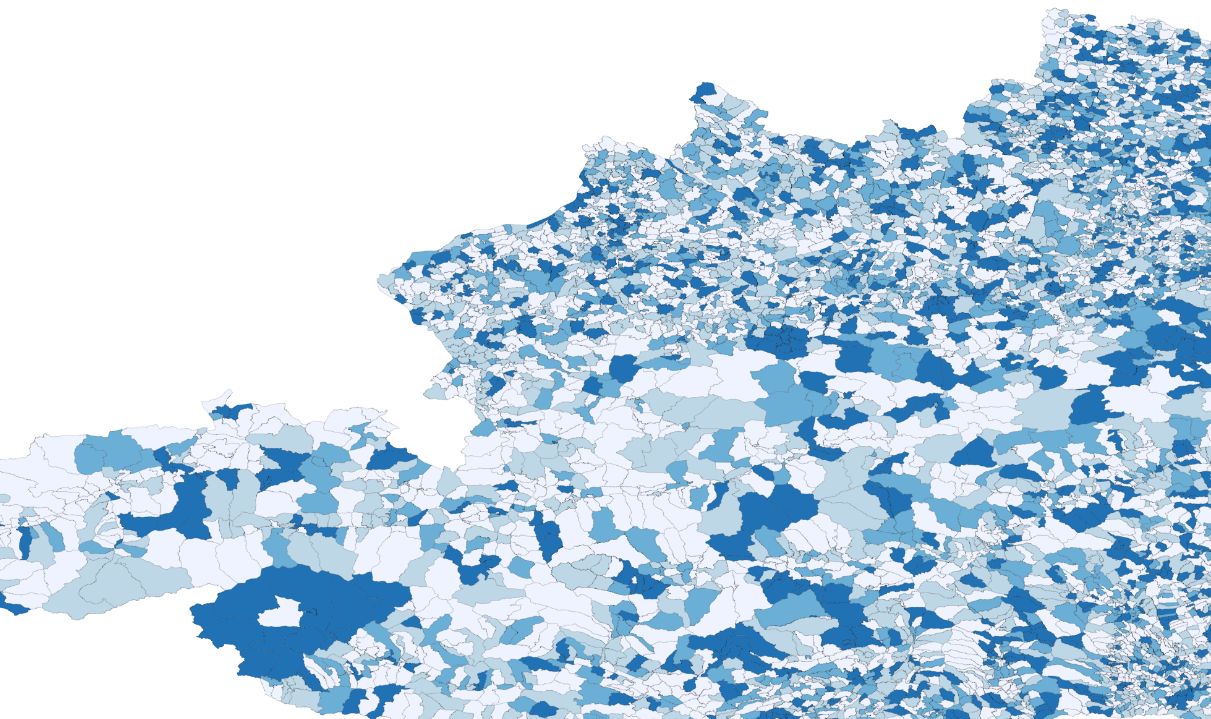
GADM (Global Administrative Areas) is the dataset most GIS professionals reach for when they need administrative boundaries outside their home country.
National statistical agencies publish their own boundary files, but each uses different formats, projections, attribute schemas, and licensing terms. GADM solves this by providing a single, consistently structured global dataset — same attribute naming, same level hierarchy, same download format — for every country. That consistency is what makes it practical for cross-border analysis, multinational reporting, and any project that needs to aggregate or compare data across countries without first harmonizing a patchwork of national boundary sources.
The other role GADM fills is as a base layer for joining tabular data to geography. Census tables, health statistics, election results, and economic indicators are all published against administrative units — and GADM provides the polygons those tables attach to. This makes it a foundational layer in workflows spanning demographic analysis, market research, public health mapping, and humanitarian response.
For countries where official boundary files are difficult to access or not published openly, GADM is often the only practical option at sub-national resolution. The main consideration is licensing: GADM is free for academic and non-commercial use, but commercial projects should evaluate geoBoundaries as an alternative with a fully open license.
