Data Sources/WorldPop

WorldPop

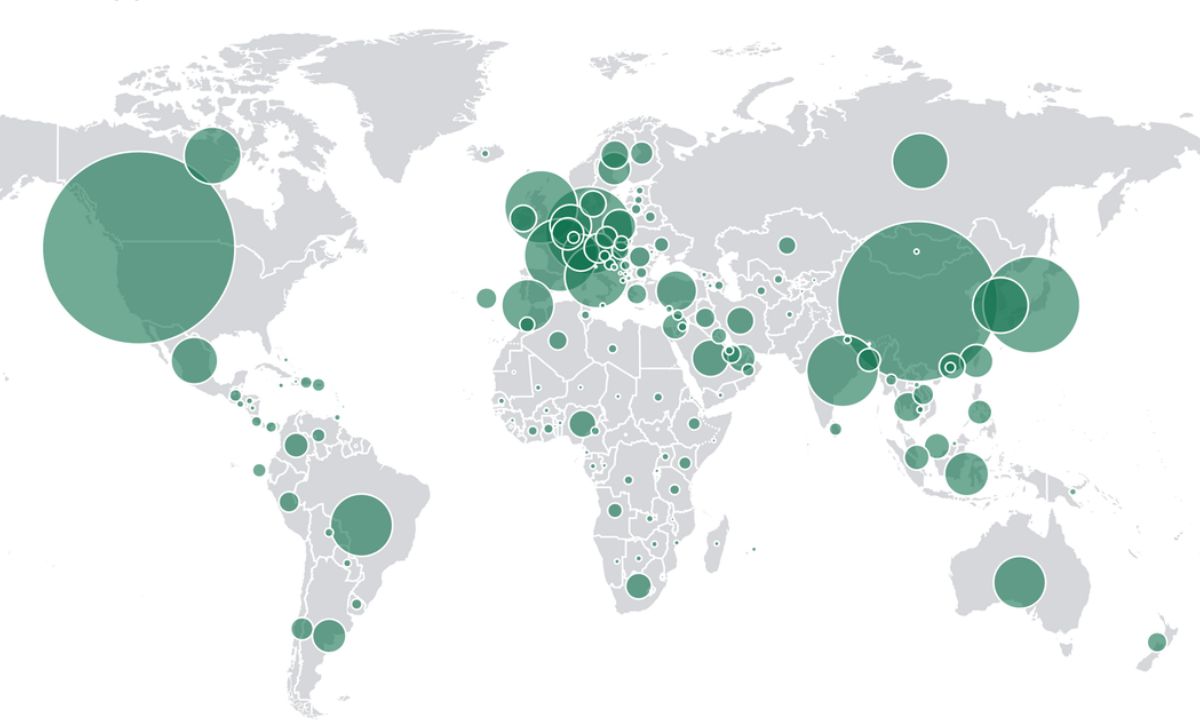
Open, high-resolution population data from WorldPop gives GIS users a detailed view of where people live.

Demographic Analysis

Understand population distribution, socioeconomic trends, and community characteristics through spatial demographic data.

Humanitarian Aid

Coordinate disaster relief, refugee support, and development programs using population and crisis data.

Public Health

Map disease patterns, healthcare access, and population health indicators for better public health decision-making.

WorldPop

WorldPop answers the question that census tables alone can't: where exactly within an administrative unit do people live? Census data tells you a district has 50,000 residents, but not whether they're concentrated in a town center or spread across scattered settlements.

WorldPop uses dasymetric mapping — redistributing census populations based on building footprints, roads, land cover, and settlement patterns detected from satellite imagery — to produce gridded population estimates at 100-meter resolution for every country. The result is a continuous population surface that reflects actual settlement patterns rather than administrative averaging.

This matters practically because most spatial analysis that involves people — disaster impact estimation, health service planning, infrastructure demand modeling, climate exposure assessment — needs to know where populations are concentrated, not just how many people a district contains. WorldPop provides that spatial specificity at a globally consistent resolution, which is especially valuable in developing countries where census data may be old, coarse, or unavailable at sub-district level.

The demographic breakdowns (age, sex, births, poverty) add further analytical depth: a health ministry targeting vaccine campaigns needs to know where children under 5 are concentrated, not just total population. WorldPop complements rather than replaces census data — it needs census totals as input constraints — but it adds the spatial redistribution that turns administrative statistics into usable population surfaces for GIS analysis.

Frequently Asked Questions

WorldPop is a research project at the University of Southampton that produces open, high-resolution gridded population datasets for every country, using satellite imagery, census data, and machine learning.

Most datasets are available at 100-meter and 1-kilometer resolution as GeoTIFF rasters covering the entire globe.

Yes. All WorldPop datasets are freely available under open licenses from worldpop.org.

WorldPop uses machine learning to redistribute census populations based on settlement patterns and land use, producing more realistic spatial distributions. GPW (from SEDAC) distributes population more uniformly within administrative units.

Age and sex structure, births, pregnancies, urban change, migration flows, poverty estimates, and building footprint density — all gridded at high resolution.

Details

CoverageGlobal
Layer TypeRaster
Update FrequencyAnnual
Categories
Remote Sensing
Visit sourceUse data in Atlas

Discover more data sources

Mapillary

Crowdsourced street-level imagery covering 190+ countries, with AI-detected map features like signs and road markings.

Mapping

European Space Agency

ESA Earth Observation Data provides free, high-resolution satellite imagery from the Sentinel missions, covering land, ocean, and atmosphere. With data for climate monitoring, disaster response, and GIS applications, it's a top resource for researchers and professionals.

Remote Sensing

United States Census Bureau

The U.S. Census Bureau provides the core demographic and geographic data for GIS mapping in the U.S.

Demographic

STAC Index

The STAC Index catalogs open, cloud-native geospatial datasets using the STAC metadata standard.

Demographic

FEMA Flood Maps

Official U.S. flood hazard zones, base flood elevations, and floodplain boundaries used for insurance and planning.

Mapping, Climate

OpenCage Geocoding API

OpenCage provides a straightforward geocoding API built on open data sources including OpenStreetMap, GeoNames, and others. It offers forward and reverse geocoding for addresses and coordinates globally, with transparent pricing and no lock-in to a single data provider.

Geocoding, Developer Tools

Global Flood Database

The Global Flood Database offers satellite-derived maps of 913 flood events from 2000 to 2018, detailing extent and duration.

Demographic

National Geospatial-Intelligence Agency

The National Geospatial-Intelligence Agency (NGA) provides free, high-quality geospatial data, including elevation models, topographic maps, and navigation resources.

Mapping