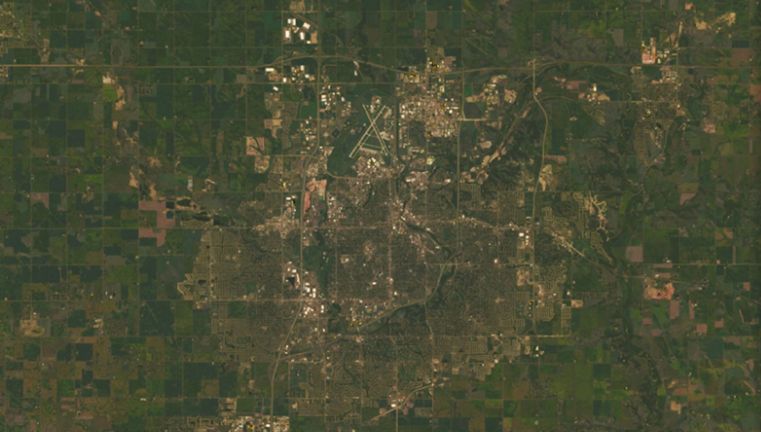
LandsatLook Viewer has been retired. You can access Landsat and Copernicus satellite data through Atlas' built-in integration. See video below for more details.
LandsatLook Viewer is the browser-based gateway to the longest continuous satellite imagery archive on Earth. The Landsat program has been collecting multispectral observations since 1972 — over half a century of consistent global coverage — and LandsatLook makes the entire archive searchable and downloadable without specialized tools or command-line workflows.
For GIS professionals, this temporal depth is Landsat's defining advantage: Sentinel-2 offers higher resolution and faster revisit, but if you need to compare a landscape in 2024 to what it looked like in 1985 or 1972, Landsat is the only free option with that reach.
The 50-year archive makes Landsat the backbone of long-term change analysis — deforestation studies, urban expansion monitoring, glacier retreat tracking, and coastal erosion mapping all depend on the ability to compare imagery across decades. The multispectral bands support NDVI vegetation analysis, burn severity assessment, surface temperature mapping, and water body delineation from a single data source.
LandsatLook simplifies the discovery step: search by location and date, preview band combinations, and download GeoTIFFs that feed directly into QGIS, ArcGIS, Atlas, or Google Earth Engine. For most Earth observation workflows, Landsat data doesn't need to be the only satellite source you use — but its archive is the one that gives you historical context no other mission can match.
