Data Sources/Global Forest Watch

Global Forest Watch

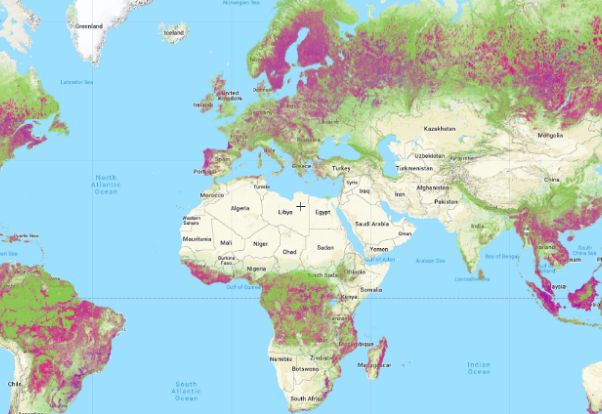
Global Forest Watch (GFW) is a free, real-time forest monitoring platform providing satellite data on deforestation, wildfires, and land use.

Forestry & Wildfire Management

Monitor forest cover, detect active fires, and plan wildfire prevention using satellite and sensor data.

Environmental Monitoring

Track environmental changes including deforestation, pollution levels, and ecosystem health using Earth observation data.

Biodiversity & Conservation

Monitor species habitats, protected areas, and ecosystem changes to support conservation and biodiversity management.

Global Forest Watch

Global Forest Watch (GFW) has changed how deforestation is tracked and acted on. Before GFW, detecting forest loss at scale required commissioning satellite analysis or waiting for annual reports — by the time data reached decision-makers, the damage was often months old. GFW compressed that timeline to days by building an open platform that combines near-real-time deforestation alerts with two decades of annual tree cover change data, all freely accessible.

Built by the World Resources Institute with data from NASA, ESA, and the University of Maryland, it's now the standard monitoring tool used by conservation organizations, governments, commodity supply chain auditors, and law enforcement agencies tracking illegal logging.

The platform's real power is in combining detection with action. Alert systems notify subscribers when forest loss is detected in their areas of interest, and the underlying Hansen dataset provides the historical baseline to put that loss in context — whether it's part of a long-term trend or an anomalous event. GFW also layers in fire alerts, carbon stock estimates, protected area boundaries, and land use classifications, so analysts can assess not just where deforestation is happening but what's driving it and what's at stake.

For GIS workflows, the data downloads in standard formats and integrates with the broader ecosystem of environmental layers — overlay tree cover loss with GBIF species records for biodiversity impact assessment, or combine it with land cover from ESA WorldCover for landscape-level change analysis.


Frequently Asked Questions

An open-source online platform from the World Resources Institute that provides real-time data and tools for monitoring forests worldwide, including deforestation alerts, fire detection, and land cover change.

Yes. All data, maps, and analysis tools on GFW are free and open access. Data can be downloaded or accessed via API.

The Hansen tree cover loss dataset is at 30-meter resolution globally, based on Landsat imagery. Deforestation alerts (GLAD) are updated weekly at 30m and near-real-time alerts (RADD) at 10m in the tropics.

Annual tree cover loss data from 2001 to present. Near-real-time deforestation alerts updated weekly. Fire alerts updated daily using VIIRS and MODIS satellite data.

Yes. GFW allows you to draw custom areas of interest, upload shapefiles, or select countries/regions and set up automated deforestation and fire alert subscriptions via email.

Details

CoverageGlobal
Layer TypeRaster
Update FrequencyWeekly
Categories
Biodiversity
Visit sourceUse data in Atlas

Discover more data sources

ACLED — Armed Conflict Location & Event Data

ACLED (Armed Conflict Location & Event Data Project) provides free real-time data on political violence, conflict events, and protests globally. Used by researchers, NGOs, governments, and journalists to track and analyze conflict patterns with precise location and date information.

Conflict, Humanitarian, Real-time

American Community Survey

The American Community Survey (ACS) provides detailed U.S. demographic and socioeconomic data ideal for GIS analysis.

Demographic

FIRMS

Near real-time active fire detections from NASA satellites, updated multiple times daily with 3–4 hour latency.

Remote Sensing, Climate

Natural Earth

Natural Earth is a free and open-source GIS data source, providing high-quality vector and raster datasets for cartographers, researchers, and GIS professionals. With political boundaries, physical geography, and infrastructure data, it's easy to use and well-organized. Available in multiple scales and standard formats, Natural Earth is a must-have for mapping and spatial analysis projects. Download it today!

Mapping

Geofabrik

Geofabrik provides free, structured OpenStreetMap (OSM) data extracts for GIS, navigation, and urban planning.

Mapping

GEBCO

Global ocean bathymetry at 15 arc-second resolution from the General Bathymetric Chart of the Oceans.

Elevation

Google Earth Engine

Google Earth Engine provides free, cloud-based access to satellite imagery, climate data, and geospatial analytics.

Remote Sensing

Global Human Settlement Layer (GHSL)

The Global Human Settlement Layer (GHSL) is a free dataset from the European Commission's Joint Research Centre mapping human settlements, population distribution, and urban extent globally from 1975 to present. Used for urban growth analysis, disaster risk assessment, and population modeling.

Demographics, Urban, Remote Sensing