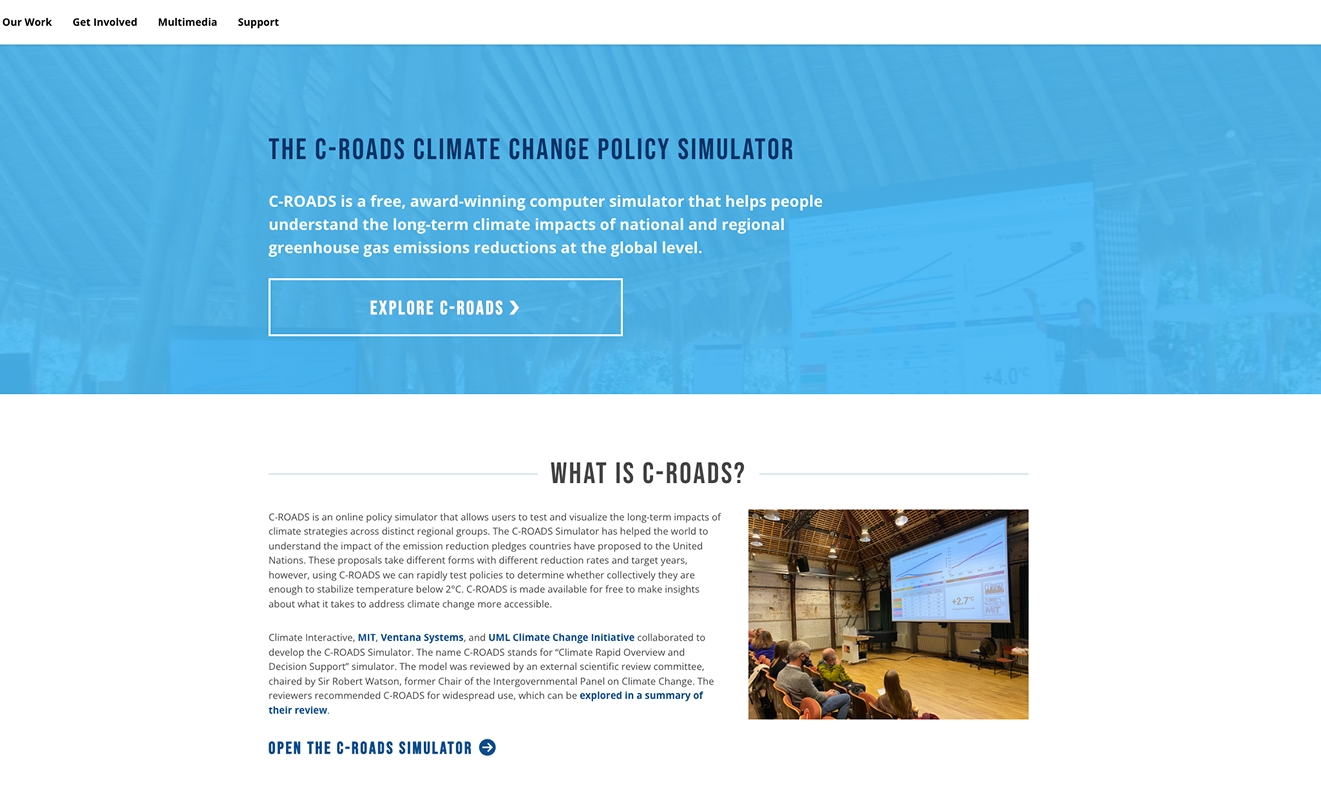
Climate Interactive C-ROADS is a powerful, free climate policy simulator that helps users understand the long-term climate impacts of various actions and policies around the world.
Developed by Climate Interactive in partnership with MIT Sloan School of Management, C-ROADS allows policymakers, educators, and researchers to simulate global climate scenarios and explore the effects of different carbon emission reduction strategies and international cooperation frameworks.
Whether you're analyzing climate policy proposals, conducting educational workshops, supporting international negotiations, or researching mitigation strategies, C-ROADS provides accessible insights into complex climate dynamics and policy effectiveness.
1. Free Climate Policy Simulation
C-ROADS provides completely free access to sophisticated climate modeling capabilities.
- No subscription or licensing fees
- Web-based interface accessible from any browser
- Downloadable version available for offline use
This makes it an ideal tool for policy analysis, education, and research.
2. Comprehensive Scenario Modeling
The simulator allows users to model various climate policy scenarios and interventions:
Policy Mechanisms:
- Carbon pricing and carbon taxes
- Renewable energy subsidies and targets
- Energy efficiency standards and programs
- Deforestation reduction policies
- International climate finance
Regional and Global Analysis:
- Country-specific policy implementations
- Regional cooperation frameworks
- Global temperature and emissions projections
- Economic impact assessments
- Co-benefits analysis (air quality, health, jobs)
Users can adjust policy parameters and immediately see the projected impacts on global temperature rise, CO2 concentrations, and economic indicators.
3. Educational and Policy Applications
C-ROADS is widely used for:
- Policy development and analysis
- Climate education in universities and schools
- Stakeholder engagement and workshops
- Research on climate mitigation strategies
- International negotiations support
The tool has been used in UN climate conferences and by governments worldwide.
4. User-Friendly Interface
Despite its sophisticated modeling capabilities, C-ROADS features:
- Intuitive controls for adjusting policy parameters
- Real-time visualization of results
- Clear graphs and charts showing temperature and emissions projections
- Scenario comparison tools
- Export capabilities for reports and presentations
5. Integration with Climate Science
C-ROADS is built on peer-reviewed climate science and integrates with:
- IPCC climate models and assessments
- National climate commitments (NDCs)
- Economic modeling frameworks
- En-ROADS energy simulator for detailed energy analysis
- Climate impact databases for regional effects
Getting Started with C-ROADS
- Visit the web simulator at climateinteractive.org
- Explore default scenarios to understand baseline projections
- Adjust policy levers to see impacts on global temperature
- Compare scenarios to evaluate different strategies
- Export results for further analysis or presentation
Use Cases
- Policy Impact Assessment: Evaluate proposed climate policies
- Educational Workshops: Teach climate dynamics and policy effects
- Research Projects: Analyze long-term climate scenarios
- Stakeholder Engagement: Facilitate discussions on climate action
- International Cooperation: Model collaborative climate strategies
C-ROADS democratizes access to climate modeling and empowers users to explore the complex relationships between human actions and climate outcomes.
