Data Sources/Caribbean Sea and Wider Caribbean

Caribbean Sea and Wider Caribbean

Regional environment monitoring platform facilitating compilation of information from national monitoring and assessment programmes across the Caribbean region for environmental data sharing and conservation coordination.

Caribbean Sea and Wider Caribbean

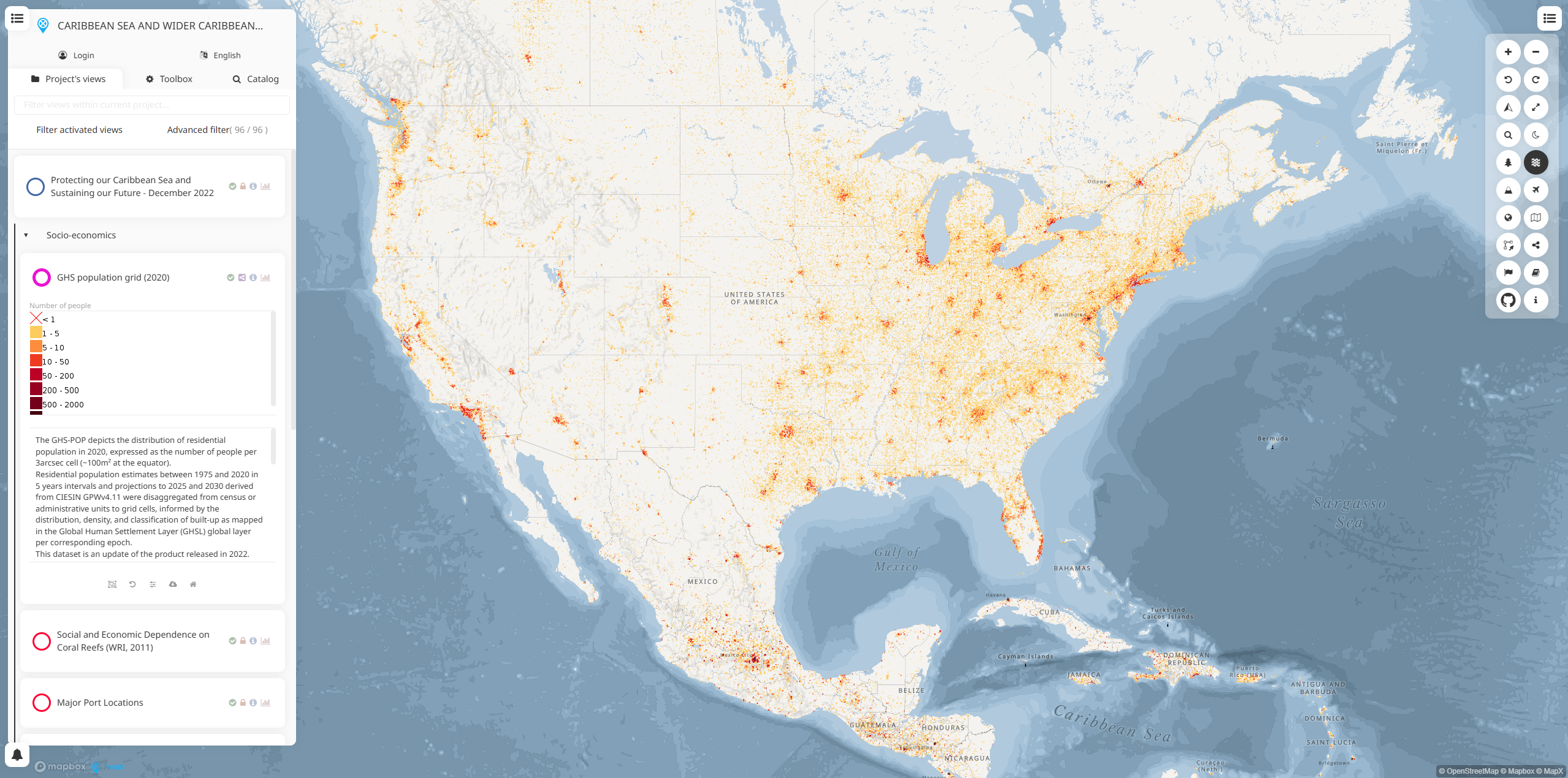
Caribbean Sea and Wider Caribbean is a specialized regional environmental monitoring platform within the UNEP World Environment Situation Room (WESR) network. It facilitates the compilation, integration, and dissemination of environmental information from national monitoring and assessment programs across the Caribbean region.

The platform serves as a central hub for environmental data sharing, enabling Caribbean nations to access standardized environmental information, track regional trends, and coordinate conservation efforts across the marine and coastal ecosystems of the Caribbean Sea and surrounding areas.


Key Features

  • Regional data integration from national monitoring programs across Caribbean countries
  • Interactive mapping interface for visualizing environmental conditions and trends
  • Multi-thematic data layers covering marine, coastal, and terrestrial environments
  • Country-specific environmental indicators and assessment reports
  • Real-time monitoring capabilities for tracking environmental changes
  • Data sharing protocols facilitating regional cooperation and coordination

Applications

  • Regional environmental assessment for tracking ecosystem health across the Caribbean
  • Marine conservation planning for protecting coral reefs, seagrass beds, and marine habitats
  • Coastal zone management supporting sustainable coastal development and protection
  • Climate change adaptation planning based on regional environmental trends
  • Pollution monitoring tracking contaminants and their impacts on marine ecosystems
  • Biodiversity conservation efforts across terrestrial and marine protected areas

Environmental Coverage

  • Marine water quality including nutrient levels, pollution indicators, and pH measurements
  • Coral reef health monitoring bleaching events, coverage, and biodiversity metrics
  • Coastal erosion and sea-level change impacts on Caribbean shorelines
  • Fish stocks and marine biodiversity assessments
  • Land use changes affecting coastal and marine environments
  • Climate variables including temperature, precipitation, and storm patterns

Regional Collaboration

  • Multi-country data sharing through standardized monitoring protocols
  • Regional reporting supporting Caribbean environmental policy development
  • Capacity building initiatives for national environmental monitoring programs
  • Scientific research support providing data for regional environmental studies
  • International cooperation with global environmental monitoring networks

The Caribbean Sea and Wider Caribbean platform represents a critical resource for regional environmental governance, supporting evidence-based decision-making and coordinated conservation efforts across one of the world's most biodiverse marine regions.

Details

Categories
Environmental Monitoring
Visit sourceUse data in Atlas

Discover more data sources

U.S. Geological Survey

The U.S. Geological Survey (USGS) offers essential GIS data on terrain, water, land cover, and natural hazards in the U.S.

Demographic

Natural Earth

Natural Earth is a free and open-source GIS data source, providing high-quality vector and raster datasets for cartographers, researchers, and GIS professionals. With political boundaries, physical geography, and infrastructure data, it's easy to use and well-organized. Available in multiple scales and standard formats, Natural Earth is a must-have for mapping and spatial analysis projects. Download it today!

Mapping

USGS Earth Explorer

USGS Earth Explorer is one of the best free sources for satellite imagery and geospatial data. With access to Landsat, Sentinel, MODIS, and elevation models, it provides high-quality data for GIS, environmental monitoring, and urban planning. Its extensive historical archive and multiple formats make it a valuable tool for professionals and researchers.

Remote Sensing, Elevation

OpenCage Geocoding API

OpenCage provides a straightforward geocoding API built on open data sources including OpenStreetMap, GeoNames, and others. It offers forward and reverse geocoding for addresses and coordinates globally, with transparent pricing and no lock-in to a single data provider.

Geocoding, Developer Tools

SoilGrids

Global soil property maps at 250m resolution covering texture, organic carbon, pH, and more from ISRIC.

Biodiversity, Climate

OpenAddresses

OpenAddresses is a global open data project providing geocoded street address data for GIS and geocoding applications.

Demographic

FAO GeoNetwork

FAO GeoNetwork provides free, high-quality geospatial data for agriculture, food security, land use, and climate research. With global datasets, interactive maps, and GIS-ready formats, it's an essential tool for researchers, policymakers, and sustainability experts.

Biodiversity, Climate

Marine Regions

Marine Regions is a standard list of georeferenced marine names and boundaries combining multiple authoritative sources, including Exclusive Economic Zones (EEZs), the IHO Sea Areas, and other marine geographic features. Essential for ocean GIS, fisheries management, and maritime policy analysis.

Marine, Boundaries, Environmental