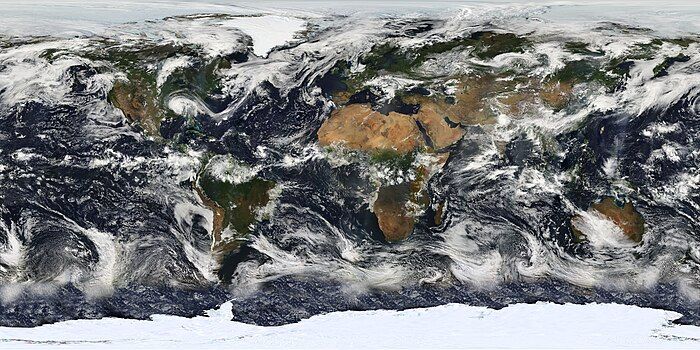
MODIS

MODIS provides free, global satellite data for climate monitoring, land cover analysis, and disaster response.

Environmental Monitoring

Track environmental changes including deforestation, pollution levels, and ecosystem health using Earth observation data.

Agriculture & Land Use

Monitor crop health, soil conditions, and land use changes for precision agriculture and sustainable land management.

Climate Analysis

Analyze climate patterns, weather trends, and atmospheric conditions for research, risk assessment, and long-term planning.

MODIS

MODIS (Moderate Resolution Imaging Spectroradiometer) occupies a unique niche in the satellite ecosystem: it trades spatial resolution for temporal frequency and thematic breadth. While Sentinel-2 and Landsat provide sharper imagery, MODIS captures the entire Earth every 1–2 days across 36 spectral bands — and has been doing so continuously since 2000.

That combination of daily global coverage and a 25-year archive makes MODIS the go-to source for broad-scale monitoring where detecting change over time matters more than resolving fine spatial detail: seasonal vegetation cycles, continental fire patterns, snow extent dynamics, and ocean productivity trends all rely on MODIS data as their observational backbone.

What makes MODIS particularly accessible is that NASA distributes it as preprocessed, analysis-ready products rather than just raw imagery. Vegetation indices, land surface temperature, fire detections, snow cover, ocean color, and atmospheric measurements are all available as standardized composites that can be used directly without the calibration and atmospheric correction steps that raw satellite data typically requires.

This lowers the barrier to entry significantly — a vegetation time-series analysis that would require substantial preprocessing with Landsat imagery can start immediately with MODIS NDVI composites. For GIS workflows that need a long, consistent baseline of environmental observations at continental or global scale, MODIS remains the most complete record available.

Frequently Asked Questions

The Moderate Resolution Imaging Spectroradiometer is a sensor aboard NASA's Terra and Aqua satellites, providing daily global coverage of land, ocean, and atmosphere since 2000.

250m, 500m, and 1km depending on the spectral band. MODIS has 36 spectral bands covering visible, near-infrared, and thermal wavelengths.

Yes. All MODIS products are freely available through NASA Earthdata, USGS LP DAAC, and Google Earth Engine.

Vegetation indices (NDVI, EVI), land surface temperature, snow cover, fire detections (active fire and burned area), ocean color, cloud properties, and aerosol measurements — all as preprocessed, analysis-ready products.

MODIS offers daily global coverage at moderate resolution (250m-1km), ideal for broad-scale monitoring. Landsat (30m, 16-day) and Sentinel-2 (10m, 5-day) provide much higher spatial detail but revisit less frequently.

Details

CoverageGlobal
Layer TypeRaster
Update FrequencyDaily
Categories
Remote Sensing
Visit sourceUse data in Atlas