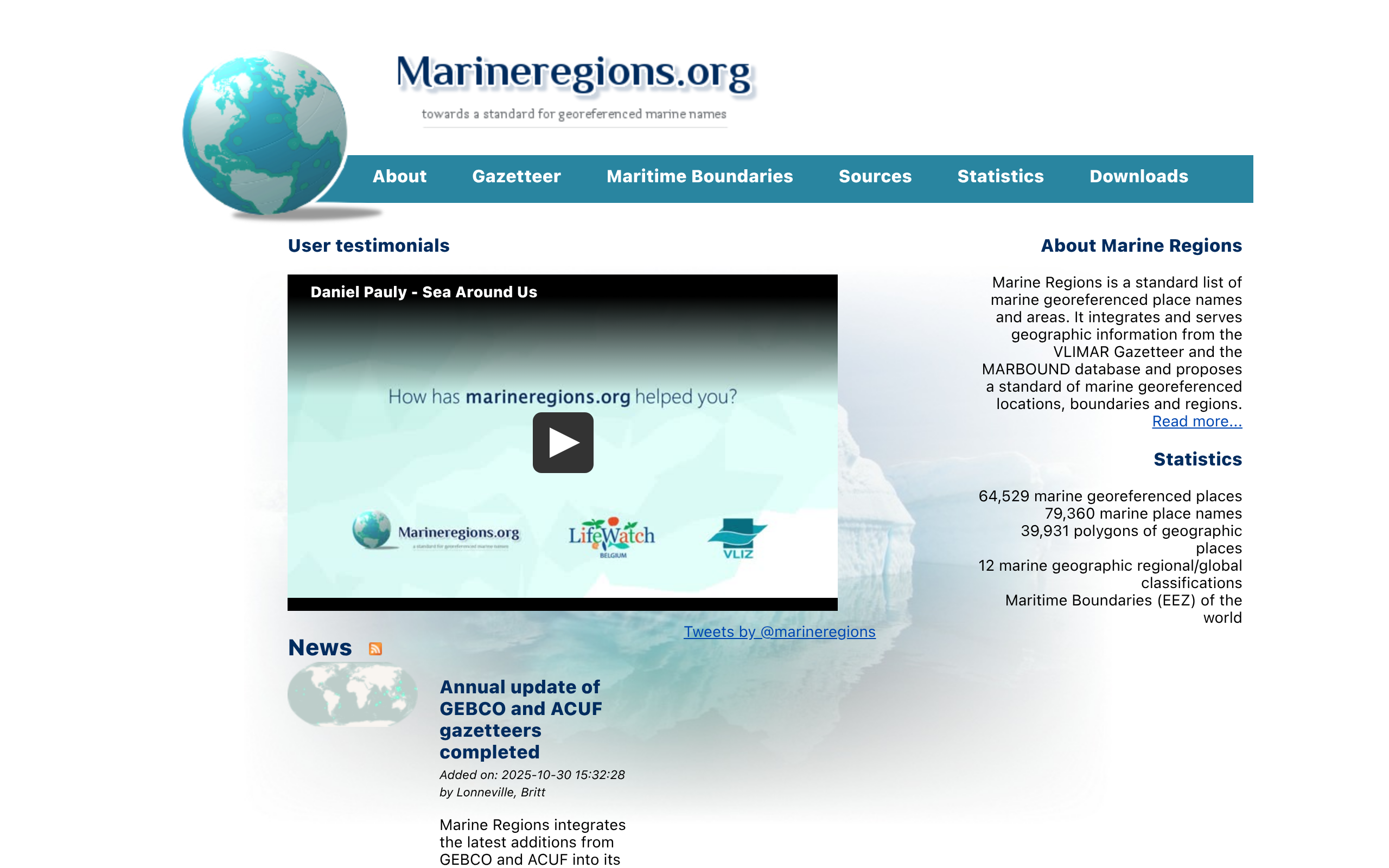
Data Sources/Marine Regions

Marine Regions

Marine Regions is a standard list of georeferenced marine names and boundaries combining multiple authoritative sources, including Exclusive Economic Zones (EEZs), the IHO Sea Areas, and other marine geographic features. Essential for ocean GIS, fisheries management, and maritime policy analysis.

Environmental Monitoring

Track environmental changes including deforestation, pollution levels, and ecosystem health using Earth observation data.

Marine Regions

Marine Regions is the authoritative reference for marine geographic boundaries and place names — the ocean equivalent of GADM for land boundaries, maintained by the Flanders Marine Institute (VLIZ) in partnership with IOC-UNESCO.

The flagship product is the EEZ (Exclusive Economic Zone) layer: the boundaries that define each country's 200-nautical-mile zone of sovereign rights over marine resources. For any analysis involving fishing rights, offshore energy, maritime jurisdiction, or ocean governance, EEZ boundaries are foundational. Marine Regions provides the current version of these boundaries, continuously updated as disputed claims are resolved and new international agreements are reached.

Beyond EEZs, the database covers the full spectrum of marine administrative and geographic units. IHO Sea Areas define named bodies of water (North Sea, Arabian Sea, Coral Sea) according to the International Hydrographic Organization's standard. ICES statistical rectangles are used for fisheries reporting across the North Atlantic. Large Marine Ecosystems define ecologically coherent ocean regions used in conservation planning. Longhurst provinces characterize oceanographic provinces based on productivity patterns.

For ocean biodiversity analysis, Marine Regions integrates with the Ocean Biodiversity Information System (OBIS) and World Register of Marine Species (WReMS) — all using the MRGID identifier system to enable consistent cross-database linking. A species occurrence record in OBIS references the same marine region as a fishing effort record from Global Fishing Watch, allowing multi-source synthesis.

The data is routinely used in research on high seas governance (analysis of activities outside any national EEZ), climate change impacts on fisheries (overlaying projected habitat shifts with EEZ boundaries), marine protected area effectiveness (what proportion of a country's EEZ has protection?), and offshore energy development permitting.

All boundary files are available as shapefiles and GeoJSON through the Marine Regions download portal, with WFS/WMS endpoints for live integration in web mapping applications.

Frequently Asked Questions

A georeferenced database of marine place names and boundaries from VLIZ (Flanders Marine Institute) and IOC-UNESCO. It provides the standard boundary files for Exclusive Economic Zones, IHO Sea Areas, ICES regions, large marine ecosystems, and hundreds of named ocean features.

Exclusive Economic Zones extend 200 nautical miles from a country's coastline, defining where nations have sovereign rights over marine resources. EEZ boundaries are essential for fisheries analysis, offshore energy permitting, maritime jurisdiction analysis, and ocean governance research.

Yes. All Marine Regions data is freely available for download under open licenses. Data is accessible via download and web services.

EEZs, territorial seas, contiguous zones, continental shelf claims, IHO Sea Areas, Large Marine Ecosystems, ICES statistical areas, Longhurst provinces, High Seas zones, and named geographic features including seas, bays, straits, and underwater features.

Shapefiles, GeoJSON, and WFS/WMS services. The MRGID (Marine Regions Geographic Identifier) system provides stable identifiers for each feature, enabling consistent reference across datasets.

Details

CoverageGlobal oceans
Layer TypeVector
Update FrequencyPeriodic
Categories
MarineBoundariesEnvironmental
Visit sourceUse data in Atlas

Discover more data sources

EOS Data Analytics

EOS Data Analytics provides high-resolution satellite imagery, AI-driven remote sensing tools, and real-time environmental monitoring.

Biodiversity, Remote Sensing

OpenStreetMap

OpenStreetMap (OSM) is one of the best free and open-source geospatial data sources. With constantly updated roads, buildings, and land use data, OSM is perfect for GIS, urban planning, navigation, and research. It offers global coverage, multiple formats, and developer-friendly APIs. Whether you need offline maps, real-time updates, or detailed geographic features, OSM is an essential tool for spatial analysis.

Mapping

geoBoundaries

geoBoundaries provides free, open political boundary shapefiles for every country in the world. Download national and subnational borders in GIS formats for mapping, analysis, and policy projects.

Demographic

Eurostat

Eurostat provides harmonized European statistics for population, economy, and infrastructure.

Demographic

Global Forest Watch

Global Forest Watch (GFW) is a free, real-time forest monitoring platform providing satellite data on deforestation, wildfires, and land use.

Biodiversity

Google Open Buildings

AI-derived building footprints for 1.8 billion buildings across Africa, South Asia, and Southeast Asia.

Mapping

Geofabrik

Geofabrik provides free, structured OpenStreetMap (OSM) data extracts for GIS, navigation, and urban planning.

Mapping

HydroSHEDS

Global hydrological data including river networks, watershed boundaries, and drainage directions from WWF.

Elevation, Climate