Data Sources/WESR Ozone

WESR Ozone

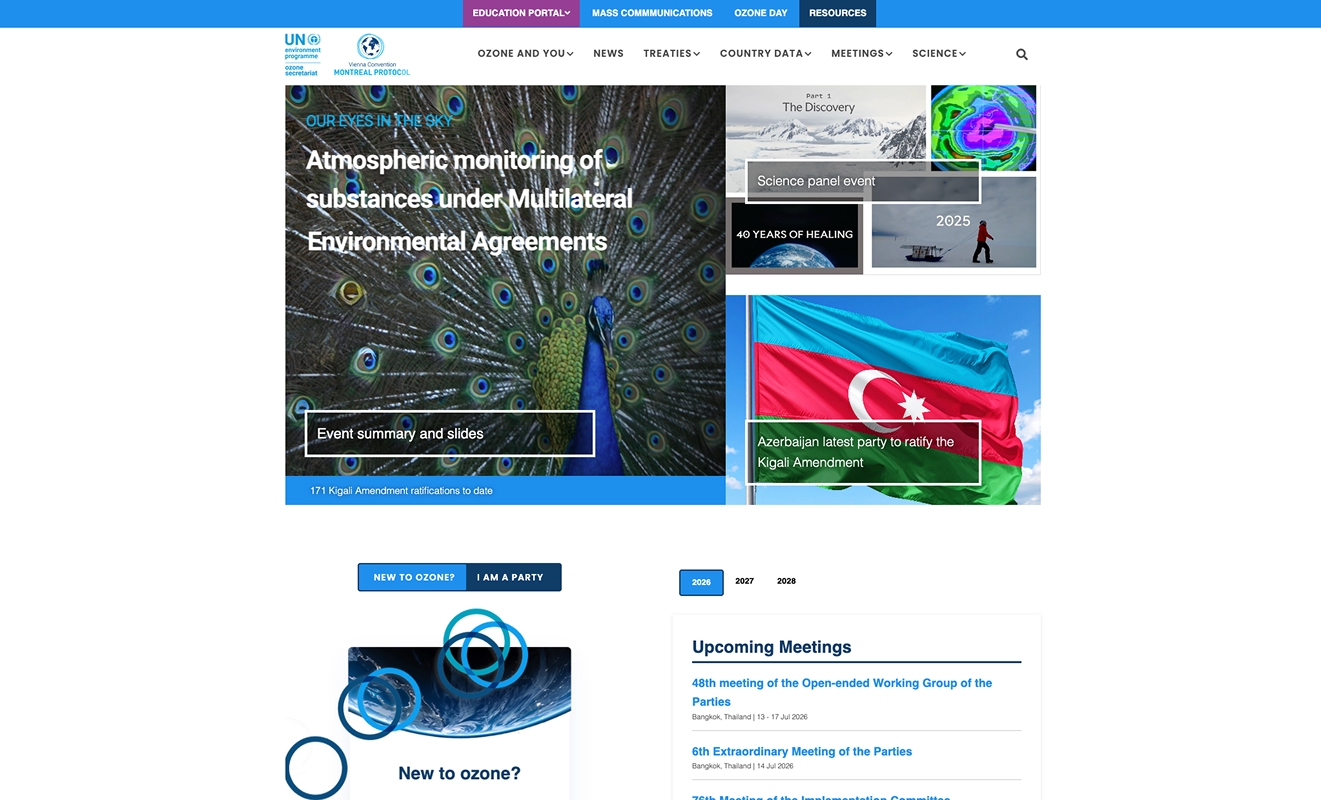
UNEP's ozone monitoring portal providing data and information on stratospheric ozone depletion, ozone layer recovery, and implementation of the Montreal Protocol and Vienna Convention for ozone layer protection.

WESR Ozone

WESR Ozone is UNEP's comprehensive ozone monitoring portal that provides data, information, and resources on stratospheric ozone depletion, ozone layer recovery, and the implementation of international agreements for ozone layer protection. The platform supports the Montreal Protocol on Substances that Deplete the Ozone Layer and the Vienna Convention, providing essential information for policy makers, scientists, and the global community.

This portal serves as the central hub for ozone-related information, tracking progress in phasing out ozone-depleting substances, monitoring ozone layer recovery, and supporting international cooperation to protect the Earth's protective ozone layer.


Key Features

  • Comprehensive data access for climate and environmental analysis
  • User-friendly interface for easy navigation and analysis
  • Scientific-grade information for reliable decision-making
  • Global or regional coverage depending on the tool's scope
  • Integration capabilities with other platforms and tools

Applications

  • Risk Assessment: Evaluate climate and environmental risks
  • Policy Planning: Support evidence-based policy development
  • Research: Access standardized data for scientific studies
  • Business Intelligence: Inform strategic business decisions
  • Educational Use: Support learning and capacity building

Getting Started

  1. Visit the platform at the provided link
  2. Explore available features and data layers
  3. Select your area of interest for analysis
  4. Access relevant data for your specific needs
  5. Export or integrate results into your workflow

Use Cases

  • Climate risk assessment for businesses and organizations
  • Environmental impact evaluation for projects
  • Research and analysis for academic and scientific purposes
  • Policy development and regulatory compliance
  • Educational and training applications

WESR Ozone provides essential capabilities for understanding and addressing climate and nature-related challenges in today's changing world.

Details

Categories
Ozone LayerMontreal ProtocolAtmospheric Monitoring
Visit sourceUse data in Atlas

Discover more data sources

Corine Land Cover

Standardized land cover maps for 39 European countries with change tracking from 1990 to 2018.

Remote Sensing, Mapping

ACLED — Armed Conflict Location & Event Data

ACLED (Armed Conflict Location & Event Data Project) provides free real-time data on political violence, conflict events, and protests globally. Used by researchers, NGOs, governments, and journalists to track and analyze conflict patterns with precise location and date information.

Conflict, Humanitarian, Real-time

Carbon Monitor

Carbon Monitor provides near-real-time estimates of daily CO₂ emissions from fossil fuel combustion and cement production globally, broken down by country and sector. Updated within days of occurrence, it enables tracking of emissions trends, policy impacts, and pandemic-related changes.

Climate, Environmental, Real-time

Global Fishing Watch

Global Fishing Watch provides free, open access data on global commercial fishing activity derived from vessel tracking systems (AIS). It enables monitoring of fishing vessels in near real-time, supporting marine conservation, fisheries management, and illegal fishing detection.

Marine, Environmental, Real-time

EOS Data Analytics

EOS Data Analytics provides high-resolution satellite imagery, AI-driven remote sensing tools, and real-time environmental monitoring.

Biodiversity, Remote Sensing

Consumer Data Research Centre

Explore the Consumer Data Research Centre's geographic datasets on UK consumer behavior, housing, and retail.

Demographic

Global Human Settlement Layer (GHSL)

The Global Human Settlement Layer (GHSL) is a free dataset from the European Commission's Joint Research Centre mapping human settlements, population distribution, and urban extent globally from 1975 to present. Used for urban growth analysis, disaster risk assessment, and population modeling.

Demographics, Urban, Remote Sensing

Mapillary

Crowdsourced street-level imagery covering 190+ countries, with AI-detected map features like signs and road markings.

Mapping